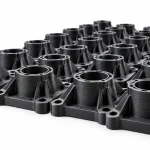

Those working in electronics and batteries know this well: designing an industrial housing means more than enclosing a component. It must protect it, ensure reliability and allow easy integration into the final system.
Traditionally, injection molding was the default choice. But at what cost? Molds costing tens of thousands of euros, long lead times and limited flexibility make this option less suitable for small and medium production runs or designs that continue to evolve.
A new approach: industrial additive manufacturing
With 3DRap Factory’s industrial FDM 3D printing, production starts directly from the CAD file, without molds. This allows:
- production to start without mold tooling
- design changes even during production
- full customization of shapes and internal layouts
This approach makes even small batches and multiple variants of the same product viable.
A practical case: housings for electronics and batteries
During a technical consultation, 3DRap Factory proposed that an electronics company replace injection molding with 3D printing to produce industrial housings.
The customer could select technical materials offering:
- high mechanical strength
- dimensional stability
- finishes suitable for industrial use
- ESD properties for the proper operation of electronic components
The result was a fully customized housing, optimized inside and out.
Water resistance and durability: the role of post-processing
Micro-porosity has traditionally been a limitation of FDM printing. To address it, 3DRap Factory recommended a certified waterproofing treatment, designed to provide:
- complete water resistance
- resistance to dust and weather
- environmental compatibility (DIN 16421 certification for contact with drinking water)
In laboratory tests, treated housings withstood up to 9 bar of pressure without absorbing liquids.
Anti-vibration mounts and smart internal layouts
Another advantage is the ability to integrate:
- dedicated internal compartments for circuit boards, batteries and sensors
- organized, protected wiring
- TPU anti-vibration mounts, which dampen shocks and vibrations
These features can extend device life and reduce the risk of failure in demanding industrial environments.

Why 3D printing can benefit electronics manufacturers
Additive manufacturing offers companies:
- no mold costs
- short lead times
- greater design flexibility
- improved market competitiveness
Industrial 3D printing can be a strategic tool for companies seeking to innovate with fewer tooling constraints.
This project shows how the combination of modular design, additive manufacturing and engineering expertise can create a real competitive advantage.
Thanks to the work of 3DRap Factory, the customer obtained a more agile, cost-effective and sustainable solution, showing how thoughtful innovation can turn a simple cart into a strategic production asset.
Parliamo del tuo progetto.
Descrivici il componente o l’esigenza produttiva. Il nostro team valuterà la richiesta e ti ricontatterà.